
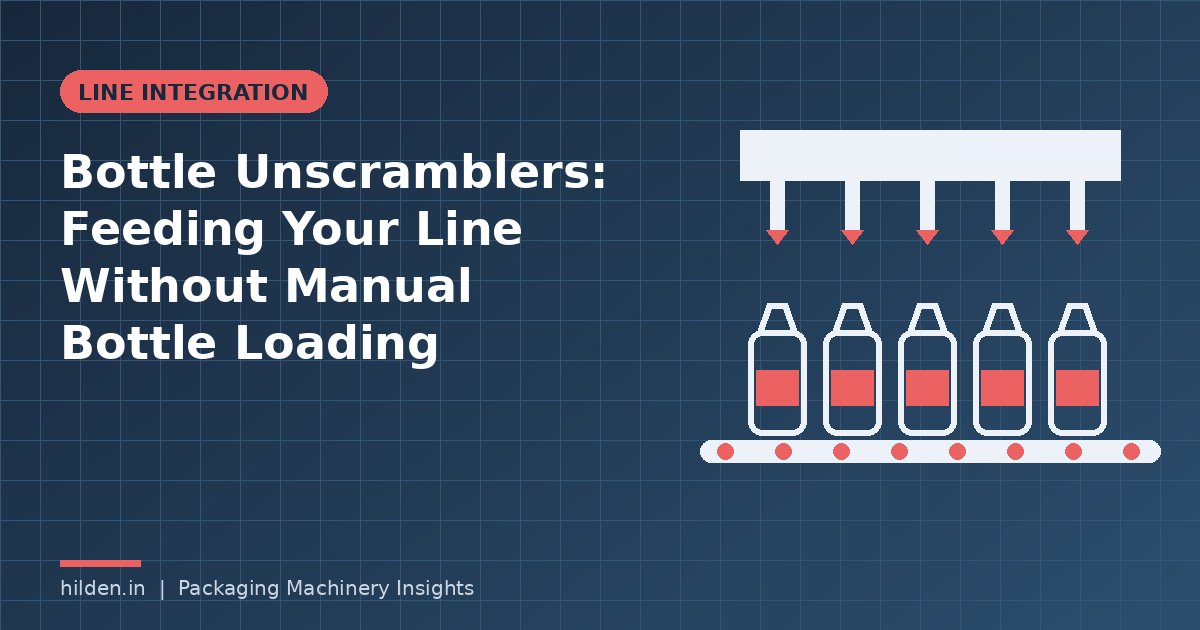
Many filling lines still begin with operators placing empty bottles onto a conveyor one by one. It works at low speeds, but as lines get faster, manual loading becomes a bottleneck and a source of errors, dust and injuries. A bottle unscrambler automatically takes bottles from bulk, orients them upright and feeds them onto the conveyor. It is one of the simplest ways to raise the output of a line.
How Unscramblers Work
Bottles are tipped into a hopper in bulk. An elevator or rotary mechanism feeds bottles into pockets or channels, where they are oriented neck-up and placed onto the conveyor. Different designs handle different bottle shapes.
Rotary Unscramblers
Rotary unscramblers use a rotating disc with pockets around the edge. Bottles fall into pockets and are dropped neck-up through funnels onto the conveyor. These machines handle round and some oval bottles at high speeds.
Linear and Elevator Unscramblers
Some designs use an elevator to lift bottles from a bulk hopper and line them up on a sorting conveyor. These are suitable for medium speeds and a range of bottle types.
Handling Different Bottle Shapes
Round bottles are easiest to unscramble. Oval, square and irregular bottles may need special pockets or orientation devices. Lightweight bottles may need air assistance. Always test your bottles with the unscrambler you are considering.
Benefits
- Removes manual loading, freeing operators for other tasks
- Supplies bottles consistently, preventing filler starvation
- Reduces handling damage and contamination
- Increases line speed
Changeovers
Changing bottle sizes may require different pockets or guides. Good designs allow quick changeovers with minimal tools.
Integration
Unscramblers are placed at the start of the line, feeding a rinser or filler. Conveyor buffers between the unscrambler and filler help maintain smooth flow.
Handling Bottles Gently
Bottles tumble and rub against each other in the hopper, which can scuff surfaces. For bottles with printed or decorated surfaces, choose an unscrambler designed for gentle handling, with controlled hopper levels and soft contact materials. Overfilling the hopper increases pressure on bottles at the bottom, so a level sensor that controls bottle supply from a bulk elevator helps. Lightweight PET bottles can deform under pressure, and squeezed bottles may not orient correctly. Monitoring scuffing and deformation during trials helps you set the right hopper levels.
Dealing With Static and Dust
Plastic bottles can carry static charge that attracts dust. Ionised air blowers at the unscrambler outlet or before filling reduce static and remove loose particles. This is particularly useful in food, pharmaceutical and personal care lines, where clean bottles are essential.
Space Planning
Unscramblers need space for bulk bottle storage and for operators to load the hopper. Bulk elevators allow bottles to be loaded at floor level and lifted into the unscrambler, improving ergonomics. Consider how bottles arrive at your plant, in bags, cartons or boxes, and plan a loading area that keeps the process clean and efficient.
Choosing an Unscrambler
Consider bottle types, required speed, space and changeover frequency. Provide bottle samples for trials.
Hilden supplies bottle unscramblers as part of complete filling lines and can help you choose a design suited to your bottles and output.